
The Challenges of Packaging Fresh Products
Packaging for meat, cured meats, sliced meats, and cheeses presents technical challenges related to maintaining freshness, preventing microbial contamination, and extending shelf life.
Specific Considerations for Meat and Cured Meats
- Vacuum breakdown: Weak seals or defective materials can cause discoloration and spoilage.
- Light sensitivity: Fresh meat is sensitive to light, which accelerates oxidation.
- Liquid exudation: The packaging material must absorb exudate without compromising the product’s appearance.
Specific Considerations for Cheese
- Product respiration: Soft cheeses do not tolerate packaging that is too airtight.
- Moisture management: Prevent hard cheeses from drying out and soft cheeses from developing mold.
- Substance migration: Contact between fatty cheese and plastic can promote the migration of additives (PVC/DEHA).
Sustainability and Functionality
- Reducing plastic use while maintaining an oxygen barrier and mechanical protection.
- Recyclability: The multilayer structures required for barriers make recycling difficult, driving the shift toward mono-rPET or biodegradable materials.
- Resealability to preserve the product after opening.
- Microplastics: Opening the packaging can release micro- and nanoplastics into the food.
These are the issues we address in the development of our packaging, including thermal and thermal transfer labels.
Top & Bottom
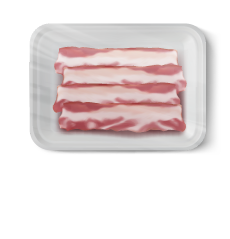
These types of processes typically require an effective barrier against oxygen and water vapor, achieved by introducing a gas mixture into the package to maximize the food’s shelf life.
To achieve this barrier, EVOH is primarily used in coextrusion with polyethylene.
Various other products applied to polyester via lacquering or coating, such as PVDC (SARAN), PVOH, or SARAN, are also used to provide a barrier.
In general, therefore, for most FRESH food products, the structures are:
TOP: PET + PE/EVOH/PE
BOTTOM: APET (ABA, i.e., two layers of amorphous PET with a central layer of recycled material or a blend) + heat-sealable or peelable PE/EVOH/PE.
The packaging is generally of the FFS (Form Fill Seal) type.
Many low-priced fresh foods or those with short shelf lives are vacuum-packed (cured meats and cheeses) using co-extruded laminates based on nylon and polyethylene (PA/PE) (FFS packaging) or packed in brine (dairy products) using laminates based on polypropylene (PP/PP) or polypropylene + polyethylene (PP/PE) (VERTICAL packaging).
Cavallotto
Generally made of cardboard

Thermoformable paper
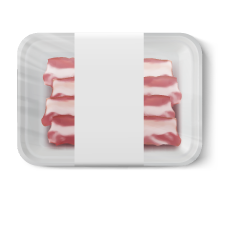
Made of special cardboard, laminated with PE/EVOH/PE that is peelable or sealable
Not suitable for complex deep drawing or deep drawing with perforations.
FFS Packaging
The same applies as for TOP&BOTTOM, but for the TOP, the printing process includes an external coat of PAPER-TOUCH or TACTILE EFFECT varnish, while the structure remains the same.
For the BOTTOM, high-strength paper is used, laminated to a peelable PE/EVOH/PE layer in appropriate proportions to obtain ATICELCA certification for disposal as PAPER.
FFS Packaging
Our Solutions for Fresh Products
Real-world solutions for the meat, deli, and cheese sectors.

Do you have a project for your fresh product?
Contact us for a packaging solution that combines shelf life, sustainability, and consumer convenience.